

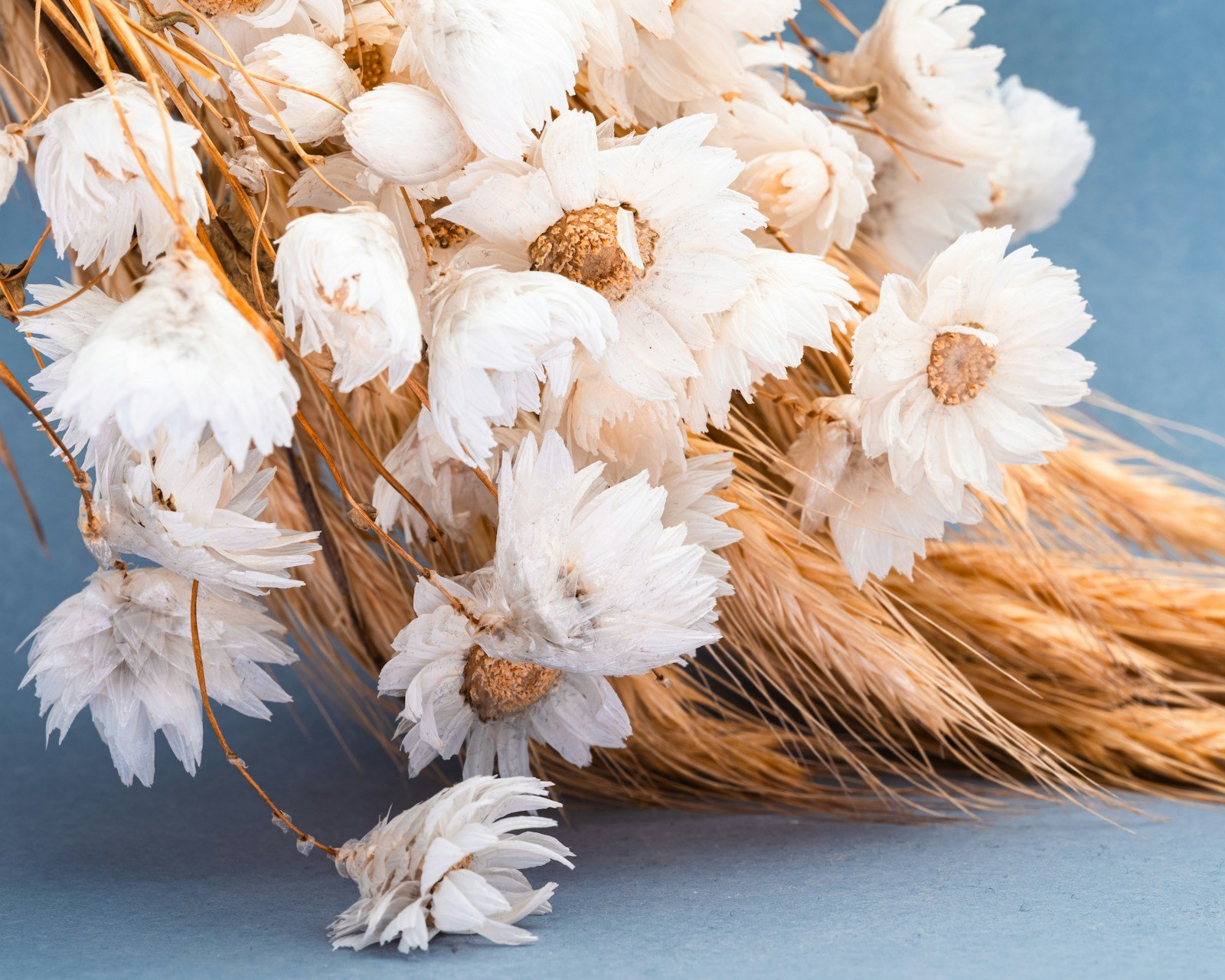
By the second week of October the buckets in the shop have changed colour. The whites and the soft summer pinks are gone, and in their place sit the rusts, the ochres, the bruised plums. Somewhere among them, every year, a customer picks up a bunch of strawflowers, turns it over, and says with genuine surprise: "Are these real?" They are. They have only been dried. And as a London florist, I will tell you that October is the month dried flowers stop being an afterthought and start being the whole point.
For years the dried flower was treated as a sad substitute, the thing you bought when you couldn't be bothered with the watering. I have never accepted that. Choosing dried in October is a proper design decision, and a clever one, with its own logic and its own rewards.
Which Dried Varieties Actually Hold Their Colour
The honest truth is that not all dried flowers age with grace. Some fade to a sad beige within a fortnight on a sunny windowsill. Four hold their tone far longer, and these are the ones worth your money.
Strawflowers keep an almost lacquered brightness, the deep rust and burgundy reading nearly black under a lamp. Hydrangea heads, cut late once the petals have already gone papery on the bush, dry to a soft antique green or a dusty plum that no dye could fake. Lunaria, the plant your grandmother called honesty, dries to those translucent silver discs that catch the light like coins scattered across a mantelpiece. And pampas, used with a sharp pair of scissors and serious restraint, brings a movement nothing else can manage.
Restraint is the whole game with pampas. Three plumes in a tall stoneware jug look considered. Fifteen look like a student flat in 2019. Knowing where to stop is most of the skill.
I keep a standing arrangement of dried hydrangea and lunaria on my own kitchen table from October through to February. It has cost me nothing since the day I cut it, and not a single visitor has failed to ask about it.
Marrying the Last Fresh Stems to the First Dried
The most beautiful October work lives in the marriage of the two.
Pure dried can tip into something static, a touch funereal if you are careless with it. So I bring in the last of the fresh, the stems that belong to the season rather than fighting it. Rosehips, fat and scarlet on their woody branches, give an arrangement the weight of the hedgerow. Then there are hypericum berries, those tight coral and bronze clusters, carrying a gloss none of the dried elements can match. And orange dahlias, caught in their very last flush before the first frost takes them, bring a fresh-cut generosity that makes everything around them feel alive.
Pair three orange dahlias with a base of dried strawflower and a few sprays of rosehip. Now you have something half permanent and half fleeting. The dahlias fade within a week. The dried structure stays put. You are watching one season hand over to the next, right there on your windowsill. If building that balance feels like a stretch on a Tuesday evening, a made-up mixed seasonal piece from the shop does the work for you, assembled fresh and ready to settle into your home the same afternoon.
A Halloween Wreath You Will Be Proud to Hang
Halloween falls on Saturday the 31st of October this year, which means front doors across Putney and Wimbledon will be doing some heavy lifting. Ask any London florist what the season really asks of a doorstep and they will tell you the same thing. The plastic option from the supermarket does a job. A wreath you have made yourself does something better, and it is far easier than people fear.
Leave the cobwebs and the orange tinsel where they are. A grown-up Halloween wreath leans into the real drama of the season, the colours of decay made beautiful. Start with a copper wire ring or a plain twig base, both cheap and reusable for years. Build the foundation first with dried foliage or a few handfuls of preserved oak leaves, wiring small bundles and laying each one to hide the stems of the last, always working in a single direction round the ring so the finished thing reads as one continuous gesture rather than a row of separate posies.
Then comes the drama. Dried strawflowers in the darkest reds you can find. Black seed heads, poppy or nigella, for a slightly sinister silhouette. Natural silver lunaria threaded through for a haunted, moonlit shimmer. Tuck in dried hydrangea wherever a gap opens up, because nothing covers ground as kindly. Once your bundles are cut the whole thing takes around forty minutes, and it will outlast the 31st by months, quietly becoming your autumn wreath as November settles in.
One hard-won piece of advice. Wire everything, never glue. Glued wreaths shed and slump within a fortnight. A wired wreath holds its shape until you choose to take it apart yourself.
The Home That Knows What Month It Is
There is a particular pleasure in walking into a home that tells you the season before anyone says a word.
In June it is sweet peas on the hall table and every window thrown open. In October it is something deeper, the faint woodiness of dried grasses, rust and plum across the room, and that papery rustle when you brush past a vase. Seasonal home flowers in October do something quieter than fill a vase. They mark time, telling yourself and everyone who crosses the threshold that you noticed the year turning.
That is what I love most about this month. The flowers stop performing and become part of the furniture, in the best possible sense. They settle in. They stay.
Cut a few stems, wire a wreath, let the rosehips do their work by the door. By the time the clocks go back, your home will already smell of autumn, and you will be the one who made it so.