

A bride once handed me a Pinterest board at nine in the morning in late July. Forty pins of garden roses, every one photographed in soft October light, every one destined for a marquee in Fulham where the afternoon would climb to 29 degrees. The flowers in those pictures would have collapsed before the speeches started. Eighteen summers as a London florist have taught me exactly what a hot afternoon does to a garden rose. So we had a long, kind conversation. By the end of it she had something better than her board: flowers that would still look like themselves at the moment she actually needed them to.
That conversation is the one I have most often. So let me save us both the trouble and have it here.
Heat Is the Thing Nobody Plans For
Summer wedding flowers in London live or die by temperature, and most couples come to me thinking about colour. I understand why. Colour is the fun part. But the prettiest palette in the world means nothing if the blooms can't hold their shape through a long, warm day.
Some flowers are simply built for heat. Zinnias, with their papery petals and stiff stems, barely notice a hot afternoon. Celosia, the velvety crested kind, looks better the warmer it gets. Lisianthus does the gentlest impression of a garden rose and lasts three times as long out of water. Scabious, ammi, sweet william, the whole tribe of summer annuals grown in British fields through June and July: these are the workhorses that keep a bouquet upright while the champagne goes flat.
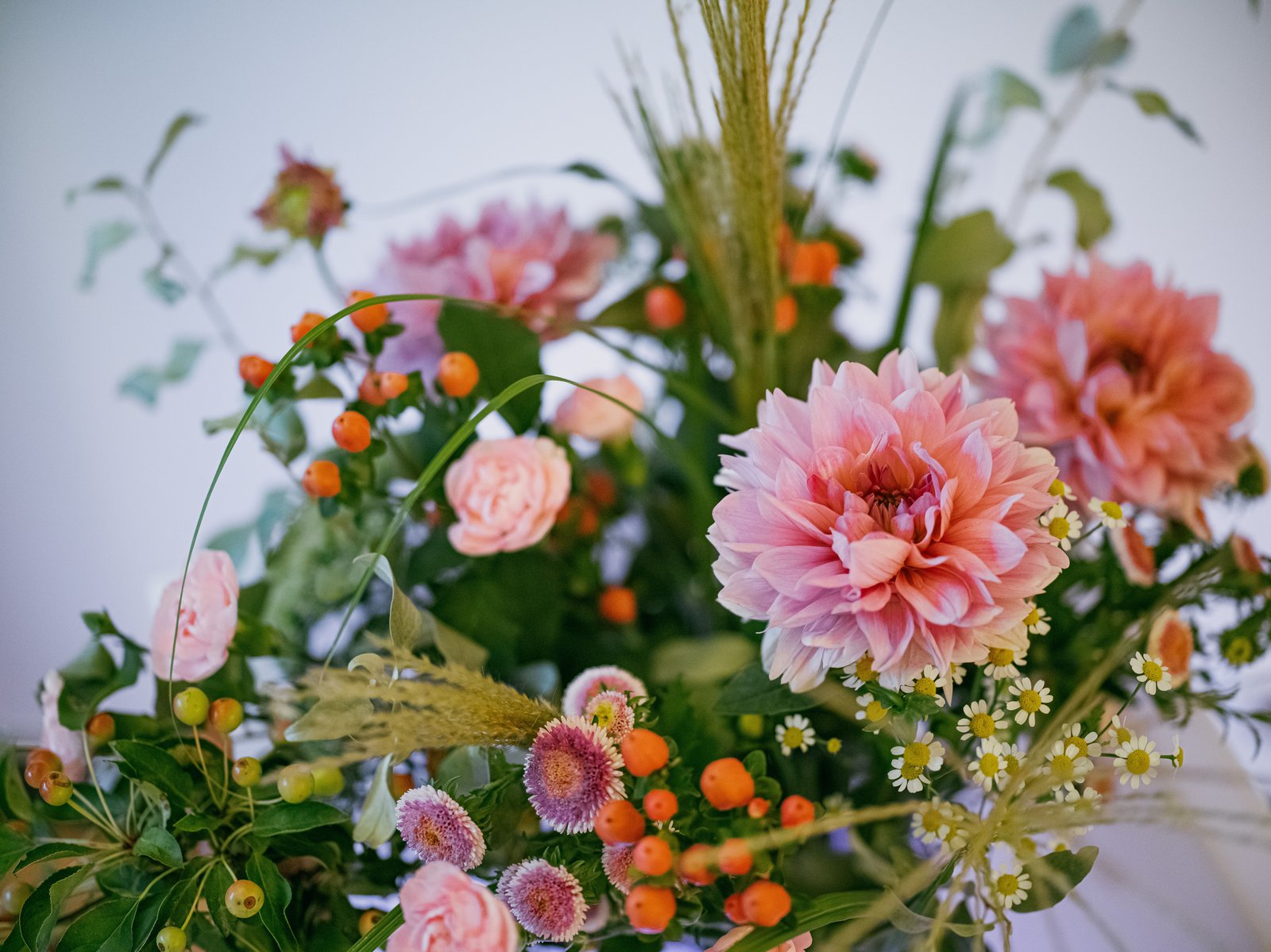
Then there are the ones that ask for protection. Hydrangeas are the famous diva. A hydrangea head is mostly water held in place by sheer optimism, and the second it gets thirsty it wilts in a way that looks like grief. We can use them, and they are glorious, but they go in last, they get conditioned overnight in deep water, and they never sit in direct sun on a windowsill before the ceremony. Dahlias are much the same. Worth every bit of the fuss, though they want cool storage and a short window between arrangement and aisle.
The honest version of this advice: tell your London florist where the flowers will physically be, and for how long. A bouquet carried for twenty minutes can be more delicate than the table arrangements baking under a marquee roof for six hours. We plan differently for each.
What's Actually in Season, and Why It Matters
There's a romance to British summer flowers that imported stems can't quite touch. June into August is the richest window of the whole British growing year, the fortnight-by-fortnight peak that field growers wait the rest of the year for. The sweet peas alone are worth booking around. A handful of properly scented English sweet peas in a buttonhole will perfume a whole row of guests, and that scent does something to a room that no photograph ever catches.
Choosing what's in season near you isn't only sentiment, though I'd argue sentiment is reason enough. Locally grown summer flowers spend hours, not days, between field and bouquet. They open more fully and hold for longer. A delphinium cut in a Surrey field on Thursday for a Saturday wedding behaves completely differently from one that travelled refrigerated from the other side of the world the week before.
For a London summer wedding I'll usually build around what the British fields are giving us that fortnight: roses and sweet peas in June, then the cornflowers and larkspur and scented stocks of high summer, then the dahlias and zinnias and amaranthus that carry us into the heavier end of August. The list shifts week to week. That's rather the point. You're getting the season at its actual peak rather than a fixed menu pretending the calendar doesn't exist.
Palettes That Survive a London July
Pale palettes are having a long moment, and they are beautiful, and I will gently warn you that white and blush show heat stress first. A bruised petal on an ivory rose announces itself across a room. The same bruise on a deep burgundy dahlia vanishes entirely.
If you're marrying in the hottest weeks, lean into colour with a clear conscience. Corals, raspberry, soft terracotta, the warm apricots that sit so well against a London brick wall or a Putney garden. These tones are forgiving in a way the pale ones are not, and they photograph with real depth in bright sun rather than washing out to nothing.
For the couples set on that soft, airy look, we get there with the tougher pale flowers. Lisianthus in place of the most fragile garden roses. White larkspur and ammi for froth that won't flop. A little structure underneath that the camera never sees but the bouquet absolutely relies on.
Timing, Logistics and the Putney-to-Hammersmith Reality
A London summer wedding has a particular shape. Often a register office or a church, then a venue across town, then a marquee or a rooftop or a restaurant, with the flowers expected to look immaculate through all three. Traffic is part of the floristry here whether we like it or not.
We condition everything the night before in our cool workroom, build in the early morning while the air is still kind, and deliver in a chilled van as late as the timeline sensibly allows. Buttonholes get made last because they spend the day pinned to a warm lapel with no water at all, which is about the hardest job you can ever give a flower. Ceremony arrangements that will move to the reception are built to be lifted and resettled without rearranging, because nobody has a spare florist standing by at six o'clock.
If you take one practical thing from all this, take this: book a consultation early with your London florist, in winter or spring if you can, and talk through the actual day rather than the mood board. The mood board tells me what you love. The day tells me what will work. The best summer weddings come from the overlap between the two.
The flowers I remember years later are rarely the most expensive ones. They're the ones that still looked alive at the end of the night, when the band had stopped and someone's grandmother was holding a slightly wilted buttonhole she refused to put down. That's what summer flowers are for. The photographs at noon will take care of themselves. What the flowers are really for comes later, in the warmth of the evening, when everyone has forgotten to look and the scent of sweet peas is still hanging in the air.